
Down Syndrome or Trisomy 21: Chromosomal disorder
Trisomy 21 or Down Syndrome was first described by John Langdon Hayden Down a Physician ( 1828-1896 AD) in The London Hospital in 1866 AD.In 1959, Lejeune and Jacobs et al independently determined -trisomy 21 as cause of Down Syndrome.
March 21st every Year is Marked as ” Down Syndrome Day” – 3rd month 21st
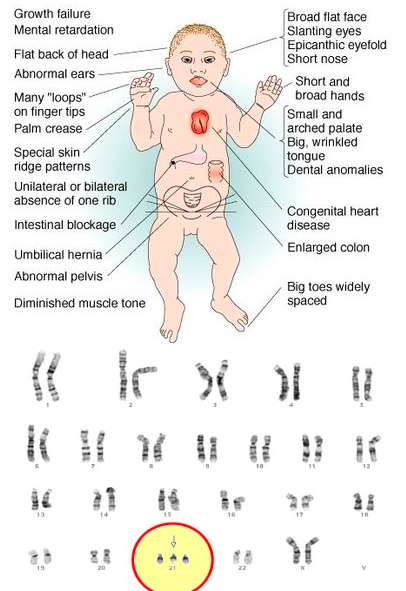
Karyotype–
- Trisomy 21: 47 XX or XY +21 . Usually caused by an extra copy of Chromosome 21
- Translocational type- 46 XX, der ( 14;21)(q10;q10),+21
- Mosaic type- 46 XX/ 47 XX ,+21
Most common of the chromosomal disorders ( incidence 1 in 700 births).Risk increases with maternal age. Significant increase in risk with Maternal age above 40 years. 1:2000 in under 25 years, 1: 300 at 35 years and 1:100 at 40 years. Co-relation with maternal age suggests that meiotic non-disjunction of Chromosome 21 occurs in Ovum.
Male:Female ratio is 1.15:1 not much difference.
Pathogenesis
- Meiotic non-dysjunction (95%)
- Robertsonian translocation (4%)
- Mosaicism due to miotic non-dysjunction during the embryogenesis. (1%) : Mosaics are people having 2 or more populations of cells within individuals. They have variable features and milder.
Clinical features-
Severe mental retardation- most common cause of genetic mental retardation. IQ is generally low to very low.
Facial features :
- Mongoloid facies-flat face,low-bridged nose, epicanthal folds, mongoloid slant of eyes
- brachycephaly commonly , microcephaly, delayed closure of fontanels, a patent metopic suture
- Absent frontal and sphenoid sinuses, and hypoplasia of the maxillary sinuses may be seen.
- low-set ears ,dysplastic ears-small ear with overfolded helix
- hypertelorism –wide set eyes
- high arched palate,open mouth with protruded and furrowed tongue ( macroglossia)
Eyes-
- Brushfield spots-speckled appearance of the iris
- Cataract and squint sometimes
- Refractive error and nystagmus
Hands-
- Simian hand- short broad hands with short stubby fingers
- Simian Crease- Single palmar flexion crease.
- Clinodactyly -( Hypoplasia of the middle phalanx of 5th finger producing incurving little finger)
- Dermatoglyphics- more than 8 ulnar loops on fingers and distal axial triradii becomes obtuse.
Foot-
- Sandal gap- Increased gap between 1st and 2nd toe
- Sub-hallucial pad of fat
- Single deep longitudinal plantar crease
Cardiovascular System-Congenital heart defects- Endocardial cushion defect leads to formation of an atrioventricular canal ( a common connection between all 4 chambers), VSD, ASD, PDA
GI system – Duodenal atresia ( ‘ double bubble ‘ sign), Hirchsprung disease, tracheo-esophageal fistula, Imperforate anus.
Other System-
- Muscular hypotonia
- Broad short neck, Short height, Growth retardation
- Atlantoaxial subluxation with spinal cord compression <1 : A delay in recognizing atlantoaxial and atlanto-occipital instability may result in irreversible spinal-cord damage and add disability like visual and auditory loss.
- Infertility
- Personality- Cheerful, fond of Music.
- Premature Aging.
- Umbilcal hernia and diastasis rectii
Increase susceptibility to-
- Increased risk ( 15-20 X) of Acute Lymphoblastic Lymphoma- Trisomy 21, GATA 1 mutation and unknown genetic alternation.
- Alzheimer disease ( by age 40 virtually all will develop Alzheimer Disease)
- Coeliac disease may be associated .
- Increased susceptibility to infection (pneumonia, otitis media, sinusitis, pharyngitis, periodontal disease)
- Autoimmune hypothyroidism and Hashimoto disease
- Hyperuricemia, Diabetes Mellitus,
Prenatal Diagnosis-
- In-utero: Triple test using Maternal serum levels of alpha-fetoprotein, hCG, and unconjugated estriol.
- Ultrasonography- increased nuchal fold >4 mm, failure to visualize fetal nasal bone at age 11-13 weeks POG,femur and the humerus tend to be shortened.
- Amniocentesis
- Chorionic Villi sampling
- Percutaneous umbilical blood sampling (PUBS)
Prognosis:
Down syndrome decreases prenatal viability and increases prenatal and postnatal morbidity as well. About 75% with trisomy 21 die in fetal life.~ 85% of infants survive to age 1 year, and 50% can be expected to live longer than age 50 years. Down Syndrome is compatible to life . With good medical care , current median age at death is 47 years.
10 Questions about Down syndrome : FAQ
Reference:
- Robbins and Cotran Pathological Basis of Disease
- Langman’s Medical embryology.
- USG measurement in down Syndrome
- Kundu Bedside Medicine
- Kaplan’s Lecture notes
- Medscape-Emedicine
Reading horrifying articles like this is why so many mothers choose to abort when told they are pregnant with a baby with Down Syndrome. Such a shame! As the mother of an AMAZING son with Trisomy 21, you did not even begin to depict the true picture of what a person with Down syndrome is like.
Your writing aided me with my seminary assignment in time. I think I will give my assignment next week.