MEDCHROME:MEDICAL AND HEALTH ARTICLES
Home » Microbiology

Microbiology of Neisseria Meningitidis


Notes on Classification, Morphology, Colony Characteristics, Biochemical Properties, Serogroups, Virulence factors, Pathogenesis, Clinical Syndrome, Epidemiology, Prophylaxis and Laboratory Diagnosis of Neisseria Meningitidis

Classification

Family: Neisseriaceae
Genus: Neisseria
Species: Neisseria Meningitidis

Morphology

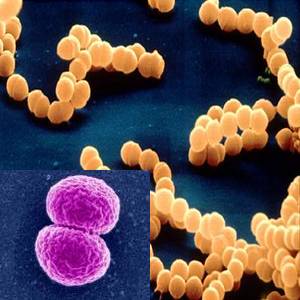
  • Gram negative diplococcus (paired)

     Microbiology of Neisseria Meningitidis

    Neisseria Meningitidis

  • Size: 0.6-0.8 μm
  • Bean shaped
  • Non-motile
  • Aerobe
  • Encapsulated

Colony characterisitics

  • Color: Bluish grey
  • Shape: Round
  • Size: About 1mm
  • Surface: Smooth
  • Elevation: Convex
  • Opacity: Transluscent
  • Consistency: Butyrous

Biochemical Properties:

  • Oxidase positive
  • Catalase positive
  • Ferments glucose and maltose with acid production
  • Gamma-glutamyl aminopeptidase positive
  • Production of Deoxyribonuclease (DNAse)
  • Nitrate negative
  • Doesn’t ferment lactose, sucrose and fructose
  • Colistin resistant

Serogroups

N. Meningitidis has been divided into atleast 13 serogroups on the basis of specificity of capsular polysaccharide antigens. These are A,B,C,D,X,Y,Z,W 135,29E,H,I,K and L. Serogroups A,B,C,X,Y,W 135 are most commonly associated with meningococcal disease.

Virulence Factors

  • Adhesion factors : Pili for adhesion to mucosa of oropharynx and meningeal tissue
  • Capsule : Antiphagocytic
  • Lipopolysaccharide : Endotoxin
  • IgA proteases : cleaves IgA protecting organism from effects of secretory IgA

Epidemiology

  • Natural habitat and reservoir : Mucosal surfaces of the human nasopharynx, urogenital tract and anal canal
  • Nasopharyngeal carriers : approximately 5-10% adults are asymptomatic carriers (may reach 90% in close communities)
  • Modes of infection: Direct contact or respiratory droplets from the nose and throat of infected people

Pathogenesis (Steps)

  1. Inhalation of contaminated droplets
  2. Adherence of organism to nasopharyngeal mucosa
  3. Local invasion and spread from nasopharynx to meninges through blood stream
  4. In meninges, organsims are internalised into phagocytic cells
  5. They replicate and migrate to subepithelial spaces
  6. Incubation period : 3-4 days

Clinical Features

  • Febrile illness : Mild and self limiting
  • Pyogenic meningitis : High fever, stiff neck, Kernig’s sign, severe headache, vomiting, photophobia, chills
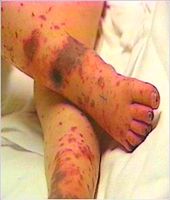
  • Meningiococcal speticemia : acute fever with chills, malaise, prostation, Waterhouse-frederichsen syndrome, DIC
  • Other Syndrome : Pneumonia, arthritis, urethritis, respiratory tract infection

Prophylaxis

meningococcal septicemia1 Microbiology of Neisseria Meningitidis

Meningococcal septicemia

a. Chemoprophylaxis :

  • Rifampicin
  • Minocycline
  • Ciprofloxacin

b. Vaccination:

  • A vaccine containing capsular polysaccharide of serotypes A and C : for infants below 2 years
  • A quadrivalent vaacine constituted by polysaccharides of serotypes A,C,Y and W-135 : for children and adults

Laboratory Diagnosis

a. Specimen:

  • CSF
  • Blood

b. Examination of CSF:

  • Increased Pressure
  • Turbid

The collected CSF is divided into 3 portions (for microscopy, for biochemical tests and for culture)

Microscopy:

  • Gram stained smear of CSF deposit commonly shows Gram negative intracellular diplococci.
  • White cell count increases to several thousand per cubic mm with 90-99% PMNs.

Biochemical tests:

  • Glucose is markedly diminished
  • CSF protein is markedly raised

c. Culture:

CSF:

  • Inoculated into chocloate agar
  • Incubated at 37c in 5-10% Carbondioxide and high humidity
  • After 24 hours bacterial colonies appear
  • The organism is tested for biochemical and agglutination reaction

Blood:

  • Blood culture is positive in over 40% cases of meningiococcal meningitis

Other Cultures:

  • Nasopharyngeal swab
  • Skin lesions
  • Joint fluid
  • Tracheal aspirate
  • Urethral discharge

d. Detection of antigen:

For Detection of Meningiococcal DNA

  • Polymerase Chain Reaction (PCR)

For detection of soluble polysaccharide antigen

  • Counter current immunoelectrophoresis (CIEP)
  • Latex agglutination test

e. Serogrouping

Popularity: 17%

Last updated: August 14, 2010


Share/Bookmark this!

3 Comments

Leave a reply

Add your comment below, or trackback from your own site. You can also subscribe to these comments via RSS.

Be nice. Keep it clean. Stay on topic. No spam.

You can use these tags:
<a href="" title=""> <abbr title=""> <acronym title=""> <b> <blockquote cite=""> <cite> <code> <del datetime=""> <em> <i> <q cite=""> <strike> <strong>


Who wrote this article?

This entry was posted by on August 14, 2010 at 7:18 pm and filed under Microbiology category.

Get Updates

Subscribe Via Email

Enter Your Email To Subscribe

Top Contributors

drsaurav
Dr. Sujit
Merry Shrestha
Jms S Mhn
tishadotson
aakriti

Log In

BMI Calculator


Jump to the BMI table »

RSS Medical Videos

Recent Comments

Relevant links

Medchrome Info

"A physician who is a lover of wisdom is the equal to a god." - Hippocrates

Medchrome offers medical students, physicians and other health professionals an easy access to medical information and education materials. It also includes simplified health articles for readers interested in health and well being.

Some of the key features of Medchrome:
Medical cases, Picture galleries, Presentations, Health and Medical Videos, Mnemonics, Medical Student life and Ebooks.

Medchrome - Blogged Health Blogs online medical magazine, usmle, mbbs, nepal Bloggers - Meet Millions of Bloggers Submit my blog General-Health