Lateral Medullary Syndrome : Wallenberg Syndrome
Regional Anatomy of PICA:
The posterior inferior cerebellar artery also known as PICA is the largest branch of the vertebral artery, passes on an irregular course between Medulla and Cerebellum. It is one of the 3 major arteries supplying the cerebellum. It supplies the posterior part of inferior surface of Vermis, Central nucleii of Cerebellum and undersurface of Cerebellar hemisphere.It also supplies Medulla ( branches of PICA along with medullary branches of Vertebral artery) and Choroid Plexus of 4 th ventricle.
Adolf Wallenberg (November 10, 1862-1949) ,a German internist and neurologist, first described the clinical manifestations (1895) and the autopsy findings (1901) in occlusions of the arteria cerebelli posterior inferior (Wallenberg syndrome)
Cause :-
- It results from thrombosis of Posterior Inferior Cerebellar Artery.
- Causing lateral part of the medulla oblongata to infarct.
- The most commonly affected artery is the vertebral artery, followed by the PICA, superior middle and inferior medullary arteries.
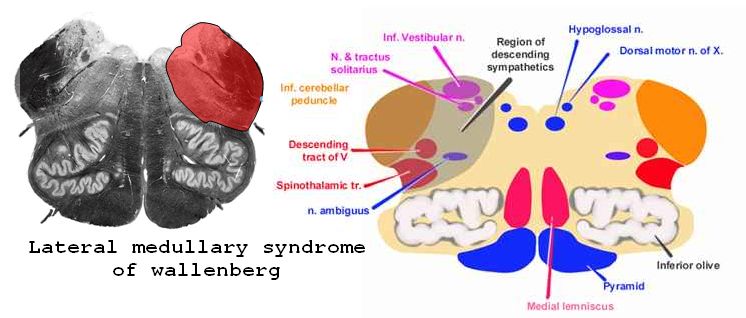
Signs and Symptoms that are Characteristic of Wallenberg Syndrome are-
- Dysphagia and Dysarthria ( Due to paralysis of Ipsilateral palatal and laryngeal muscles- Innervated by Nucleus Ambiguus)
- Analgesia and Thermaesthesia on the Ispsilateral side of the face ( Due to lesion of Nucleus and Spinal tract of Trigeminal nerve)
- Vertigo, Nausea, Vomiting and Nystagmus. ( Lesion of Vestibular nucleii)
- Ipsilateral Horner Syndrome ( due to lesion of Descending Sympathetic fibres) Mnemonic- “Horny PAMELa” for Ptosis, Anhydrosis, Miosis, Enophthalmos and Loss of ciliospinal reflex
- Cerebellar Symptoms and Signs-
- Cerebellar Ataxic/ Drunken Gait
- Dysdiadochokinesia ( unable to perform quick alternative repeated actions like pronation/supination)
- Pendular knee jerk
- Nystagmus
- Dysmetria
- Intention Tremor ( Tremor increases as fingers arrive the target)
- Hypotonia
- Rebound phenomenon
- Scanning speech
In Lateral Medullary Syndrome following structures are affected-
- Nucleus Ambiguus
- Nucleus Solitarius
- Vestibular Nucleus
- Cochlear Nucleus
- Spinocerebellar tracts
- Lateral Spinothalmic tract
- Spinal Nucleus of Trigeminal Nerve
- Tract of Trigeminal Nerve
“The Only way not to miss the Diagnosis is to keep PICA syndrome in mind, then you can head for confirmation”
I have been diagnoised with wallingberg since 11/2 yrs. Ago.
My considerations have been a burning cold right arm,disphagia exhaustion and dizziness.
Although I can drive and get around,I still deal with good and bad days.
Plan on having surgery for my vocal cord soon for I hope,peresis of right side of vocal cord.
Any advice,would be appreciated.
Having Wallenbergs Syndrome is a tough life. Also besieged with Post Stroke Pain on the left side. Can manage pain with Gabapentin but the inability to sweat, living in Florida is hell. Once the temperature goes above 77 my body temp goes up. I carry battery-powered misting fans but it’s inconvenient. Any suggestions such as medicine for anhydrosis, clothing or even somewhere to live where I am comfortable and needn’t worry about having a heat stroke?
Thanks Jemesh. It makes life simple.
many thanks.now it is much easier to remember
Wallenberg’s Syndrome (shared by Saurav Jain)
aka PICASa (picasa) = Posterior Inferior Cerebellar Artery Syndrome
characterized by: ” my DAD is Very Loving & Honest ”
D ~ Dysphagia
A ~ Ataxia (wid tendency to fall to the involved side)
D ~ Dysphonia
V ~ Vertigo,Nausea, Vomiting
L ~ Loss of pain & temperature sensation on same side of face & contralateral side of limbs.
H ~ Horner’s syndrome.
Thanks Jemesh,
Loved the Mnemonic.
I always had a hard time with PICA syndrome now I can remember it easily.
🙂
you are welcome jagdish !
Im glad it helped you
🙂
Very nice. I was trying to fit nystagmus somewhere there. Can u suggest.