Morphology of Alcoholic Liver Disease
Alcoholic Liver Disease (ALD) is a term used to describe the spectrum of liver injury associated with acute andchronic alcoholism.
The 3 stages of Alcoholic Liver Disease are:
- Hepatic steatosis (fatty change)
- Alcoholic hepatitis
- Alcoholic cirrhosis
Interrelationships among stages of Alcoholic Liver Disease:
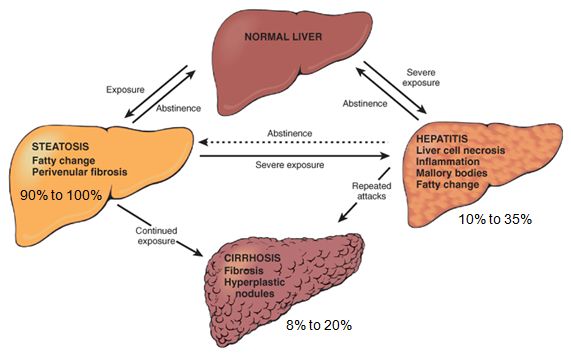
Gross appearance of Normal Liver:
Microscopic examination of Normal Liver and Hepatocytes:
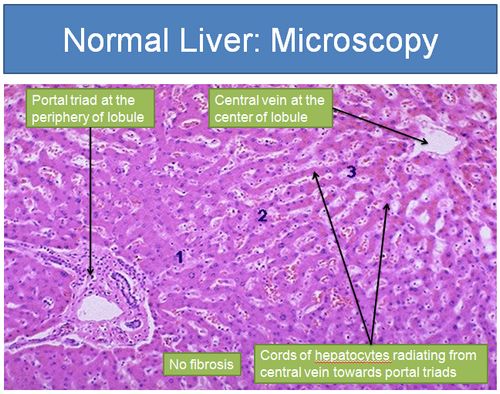
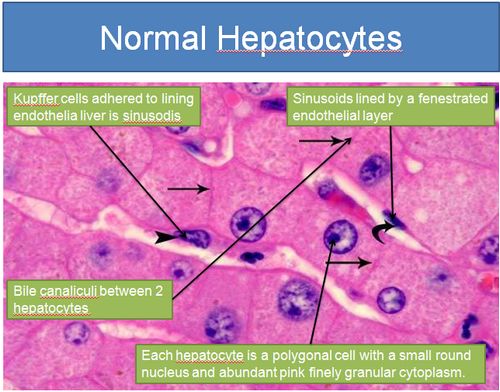
Hepatic Steatosis:
Steatosis is a condition characterized by abnormal accumulations of triglycerides within parenchymal cells. Hepatic steatosis (fatty change) is reversible even when extensive.
Gross appearance:
No gross change occurs with mild steatosis. Later, the liver is:
- Soft
- Yellow
- Greasy
- Large (up to 4 to 6 kg)
Microscopic examination:
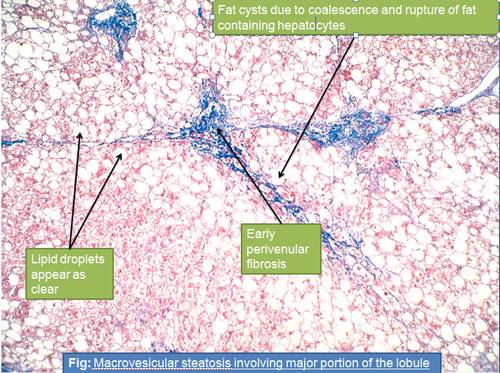
- Moderate alcohol intake: small (microvesicular) lipid droplets acculmulate in hepatocytes that doesn’t compress and displace nucleus to periphery
- Chronic alcohol intake: large (macrovesicular) globules, compressing and displacing the nucleus to the periphery of hepatocytes
- Initially, cell damage produces centrilobular fat depositions.
- But in severe cases entire lobule may be involved.
- Little or no perivenular fibrosis
Alcoholic Hepatitis
Alcoholic hepatitis develops acutely, usually following a bout of heavy drinking. In 10% to 35% of heavy drinkers, alcoholic hepatitis is superimposed on pre-existing hepatic steatosis increasing the risk of cirrhosis.
Gross appearance:
The liver is:
- Mottled red with bile stained areas
- Of normal or increased size
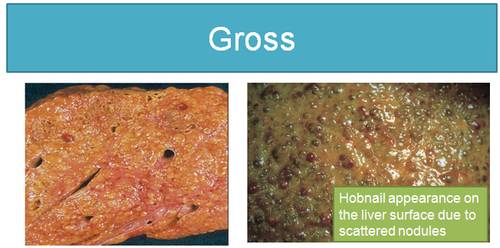
- Often contains visible nodules and fibrosis
Microscopic examination:
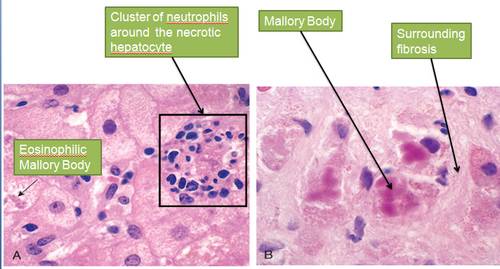
- Hepatocyte swelling (ballooning): due to accumulation of fat, water and protein.
- Hepatocyte necrosis (ballooning degeneration) which attracts neutrophils
- Mallory bodies (Cytokeratin aggresomes): Eosinophilic cytoplasmic inclusions in degenerating hepatocytes
- Neutrophilic reaction: Neutrophils surround the mallory bodies like “jackals around a campfire”
- Fibrosis: “Chicken wire” fibrosis surrounds the hepatocytes (sinusoidal, perivenular and ocassionaly periportal)
Alcoholic Cirrhosis:
Alcoholic cirrhosis is the final and irreversible form of alcoholic liver disease which usually evolves slowly and insidiously. Cirrhosis is a diffuse process (affecting whole liver) characterized by fibrosis and conversion of the liver architecture into nodules.
Gross appearance:
At Beginning: Micronodular (nodules <3cm in diameter), Yellow, Fatty, Enlarged (>2 kg)
After years: Macronodular (nodules >3cm in diameter), Brown, Non-fatty, Shrunken (<1 kg)
Microscopic examination:
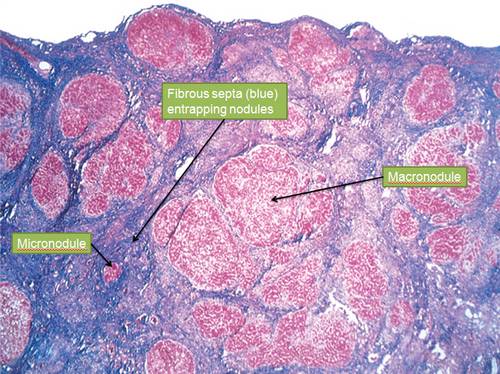
- Lobular architecture: No normal lobular architecture can be identified and central veins are hard to find.
- Fibrous septa: The fibrous septa that divide the hepatic parenchyma into modules are initially delicate and extend through sinusoids from:
- Central vein to portal regions and
- Portal tract to portal tract
- Hepatic parenchyma:
- Hepatocyte regeneration generates micronodules (parenchyma shows extensive fatty change) .
- As fibrous septa widens and surround nodules, liver becomes more fibrotic, loses fat and shrinks progressively in size.
- Mixed micronodular and macronodular pattern seen
- Laennec cirrhosis: Ischemic necrosis and fibrous obliteration of nodules create broad expanses of tough, pale, scar tissue.
- Inflammation: Sparse infiltrate of mononuclear cells in the fibrous septa
- Bile stasis

References:
- Robins and Cotran Pathological Basis of Disease 7th edition
- Robins Basic Pathology 8th edition
- Textbook of Pathology by Harsh Mohan
- Riede / Werner Color Atlas of Pathology – Thieme
- Pathology Illustrated 6th Edition by Robin Reid and Fiona Roberts
- Library.med.utah.edu
Prepared for Correlation Seminar for Gastrointestinal System in KIST Medical College by:
- Srijana Shakya (Roll no.79)
- Sulabh Shrestha (Roll no.80)
Nodular size is wrong here
Micronodular is 3mm
Thanks to notes and medical Images , it great help to researcher,
Very good presentation. Helpful for any researchrelated to Alcoholic Liver Disease