
Diagnostic Facies

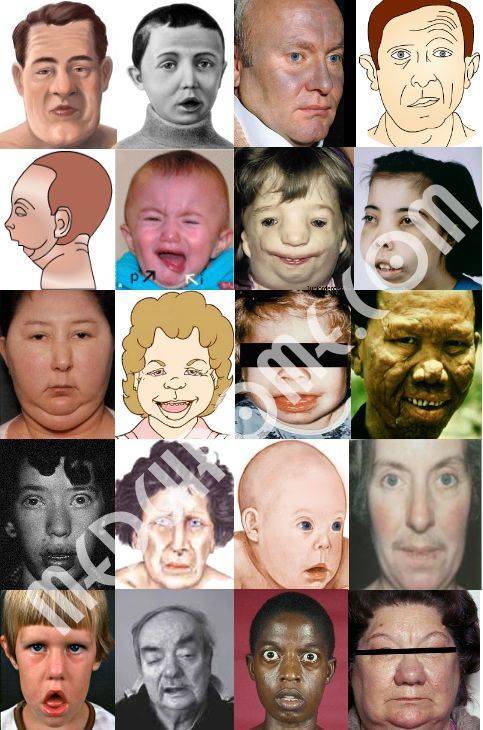
Some facial characteristics are so typical of certain diseases that they immediately suggest the diagnosis. These are pathognomic to certain disease and are called diagnostic facies. Some of the important diagnostic facies are:
Acromegalic facies (Acromegaly)
- Large supraorbital ridge and frontal bossing, thickened lips, enlarge tongue, lower jaw firm and square (protruding jaw = prognathism)
Adenoid facies (Adenoid hypertrophy)
- Long, open-mouthed, dumb-looking face of children
Amiodarone facies
- Deep blue discoloration around malar area and nose
Bell’s palsy (Facial nerve dysfunction)
- The eyelids on the paralyzed side can’t close. The mouth is drawn to the unparalyzed side, producing a somewhat grotesque appearance. Food and drink dribble from the mouth on the paralyzed side. The eye with the involved lid dries due to decreased tear production.
Bird facies (Pierre Robin Malformation)
- Small lower jaw, a slit like hole in the palate of mouth (called cleft palate) and the tongue appear to fall into the throat (condition called as retroglossoptosis)
Assymeteric crying facies (Cayler cardiofacial syndrome)
- Asymmetric appearance of the oral aperture and lips at rest, but significant depression of one side of the lower lip with animation (crying or smiling)
Bovine facies (Craniofacial Dysostosis or Crouzon syndrome)
- Convex nasal profile, shortened mandible, macroglossia
Chipmunk facies (B-Thalassemia major, Bullimia nervosa, Parotid swelling)
- Expanded globular maxillae, with BM hyperexpansion into facial bones, combined with prominent epicanthal folds
Cushingoid facies (Cushing syndrome)
- A rounded face with a double chin, prominent flushed cheeks, and fat deposits in the temporal fossa and cheeks
Elfin facies (William’s Syndrome)
- Sunken nasal bridge, puffiness around eyes, epicanthal fold, blue starry eyes, long upper lip length, small and widely spaced teeth, small chin
Gargoyle facies (Hurler syndrome)
- Head is large and dolichocephalic, with frontal bossing and prominent sagittal and metopic sutures, with mid-face hypoplasia, depressed nasal bridge, flared nares, and a prominent lower 1⁄3 of face, thickened facies, widely spaced teeth and attenuated dental enamel, gingival hyperplasia
Leonine facies (Lepromatous Leprosy)
- Peculiar, deeply furrowed, lionlike appearance of the face
MEN 2B Syndrome
- Usually there are numerous yellowish-white, sessile, painless nodules on the lips or tongue, with deeper lesions having normal coloration. There may be enough neuromas in the body of the lips to produce enlargement and a “blubbery lip” appearance. Similar nodules may be seen on the sclera and eyelids.
Parkinsonian facies (Parkinsonism)
- Mask-like, tremor of head, absence of blinking, dribbling of saliva, weakness of upward gaze, seborrhoea and sweatiness
Flat facies (Down syndrome)
- Flat appearing face, small head, flat bridge of the nose, smaller than normal, low-set nose, small mouth which causes the tongue to stick out and to appear overly large, upward slanting eyes, epicanthal fold, rounded cheeks, small misshapen ears
Mitral facies (Mitral stenosis)
- Rosy, flushed cheeks and dilated capillaries
Myotonic or Hatchet facies (Myotonic dystrophy)
- Tented, open mouth, elongated face and blunt affect
Snarling or Myasthenic facies (Myasthenia gravis)
- Drooping of the eyelids and corners of the mouth and weakness of the facial muscles
Thyrotoxic facies (Grave’s disease)
- Alert, startled, flushed and anxious appearance. Protrusion of of one or both eyes (exopthamlos) associated with retraction of the upper eyelids (lid lag) which results in the exposure of white conjunctiva above the cornea (Von-Graef’s sign)
Torpid or Myxedematous (Myxedema)
- Skin generally thickened, alopecia, periorbital oedema, xanthelasma, coolness and dryness of skin and hair, thinning of scalp hair, tongue swelling.
Others:
- Ashen gray facies (Myocardial infarction)
- Cockayne facies (Cockayne syndrome)
- Frog like facies (Intranasal disease)
- Hepatic facies (Chronic liver disease)
- Hippocratic or Cachectic facies (close to death after severe and prolonged illness like Malignancy)
- Marshall halls facies (Hydrocephalus)
- Monkey facies (Marasmus)
- Mouse facies (Chronic renal failure)
- Pagetic facies (Paget’s disease)
- Ricketic facies (Rickets)
- Uremic facies (Uremia)




2 Comments
Very informative post.thank u
excellent post really very useful thank u
Comments are closed.